
Absorption vs Exhaustion in Order Flow Trading: A Guide

Trader turned software engineer, with 4+ years building systems for crypto exchanges. Founder of AnomIQ, a real-time crypto anomaly scanner for quantitative traders.
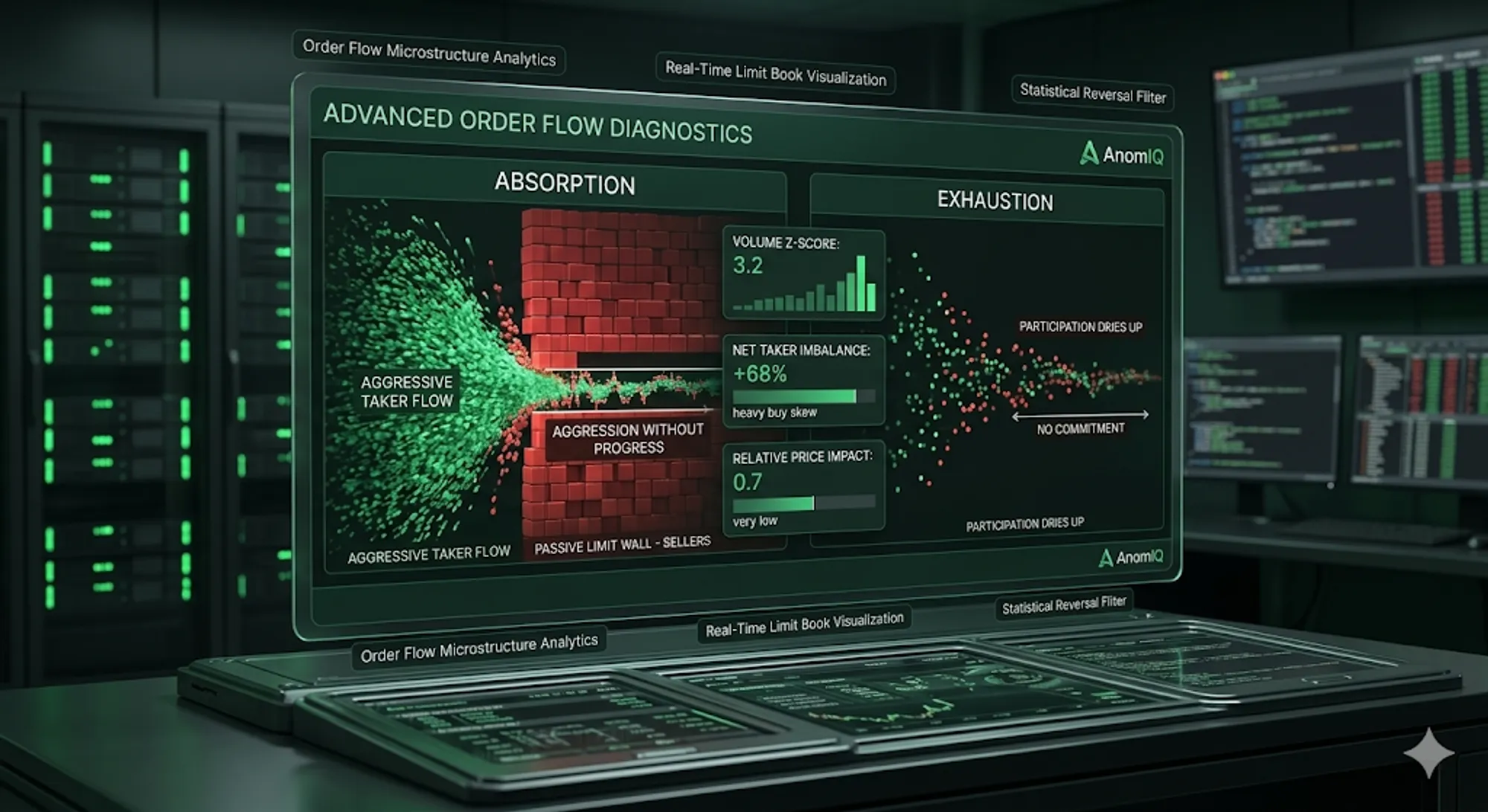
Absorption vs exhaustion in order flow trading comes down to why price stops moving. Absorption means aggressive market orders keep hitting the tape, but price fails to advance because passive limit orders are taking the other side. Exhaustion means the move stalls because aggressive buyers or sellers stop showing up with enough size.
You separate order flow absorption and exhaustion by comparing volume, taker imbalance, and price impact. High volume plus one-sided taker flow with low price impact points to absorption. Falling volume, weakening imbalance, and stalled price near the end of a move point to exhaustion. Both can precede a reversal or failed breakout, but absorption gives you a cleaner real-time scan because the market still shows heavy participation.
This is Part 1 of a two-part series.Part 2 covers real market examples with live scanner data and documented price outcomes.
For the broader scanner framework, start with Crypto Order Flow Trading: Taker Flow and Scanner Rules, then use this article for the absorption and exhaustion layer. That order-flow framework explains how volume z-score, Net Taker Imbalance, Relative Price Impact and liquidity gates combine before you label a setup as absorption or exhaustion.
Key Takeaways
- Absorption is aggressive flow that fails to move price: volume stays elevated and taker flow stays one-sided, but passive limit orders take the other side.
- Exhaustion is a move that stalls because aggressive flow stops arriving: volume fades back toward the coin’s own baseline and taker imbalance weakens.
- The distinguishing signal is participation. If volume is still statistically unusual while price stalls, read absorption; if volume is draining out of the move, read exhaustion.
- The absorption scan pairs Volume Z-Score above 3.0 and Net Taker Imbalance beyond plus or minus 60% with a Relative Price Impact that stays low for that coin. A fixed 0.8 cutoff filters almost nothing at this volume: 99.97% of qualifying minutes were already below it.
- What follows is a slight lean, not a reversal: after heavy selling, price was higher 30 minutes later in 54.9% and 51.5% of cases in two periods, against baselines of 50.2% and 47.6%.
A common mistake in market analysis: strong buy volume means price is going up, and strong sell volume means price is going down.
In modern, algorithmically driven markets, that assumption can trap you. A large spike in aggressive volume does not guarantee continuation. Some of the highest volume prints occur near the point where a trend dies.
Unusual activity alone tells you little. You need to read how price reacts to that activity.
Understanding the microstructure concepts of absorption and exhaustion is what adds context to any raw anomaly signal.
The Problem: Aggression Without Progress
Traders who rely solely on basic volume indicators or fast tape reading often get fooled by the speed of the market. They see a flurry of green market buys and assume a breakout is imminent.
But order flow requires context. If aggressive buyers are throwing millions of dollars at the market, but the price is barely moving, you are witnessing aggression without progress.
This happens because market microstructure is a two-sided mechanism: Aggressive Taker Flow (market orders) against Passive Liquidity (limit orders).
Defining the Difference
Before we can scan for these events, we must define them:
- absorption: Aggressive market orders hit the tape in outsized volume, but the price barely advances because a dense wall of passive limit orders is taking the other side of every trade. The aggressive flow is being “absorbed” by larger structural positioning.
- exhaustion: Aggressive participation simply dries up. As the price reaches the extreme of a move, the volume fades. There is no dense limit wall; the active participants have just exhausted their capital or interest.
Both can precede reversals or failed breakouts, but absorption produces a more measurable real-time signature.
Absorption vs exhaustion side by side
The same three order-flow metrics separate the two conditions. What changes is how each one behaves while price stalls.
| Absorption | Exhaustion | |
|---|---|---|
| What stops price | Passive limit orders take the other side of aggressive flow | Aggressive flow stops arriving with enough size |
| Aggressive (taker) flow | Still heavy and one-sided | Thinning out as the move extends |
| Volume Z-Score | Elevated: participation is statistically unusual for this coin | Fading back toward the coin’s own baseline |
| Net Taker Imbalance | Strongly directional | Weakening toward zero |
| Relative Price Impact | Low relative to the volume and imbalance behind it | Not the defining read: price stalls from missing flow, not from friction |
| Typical context | At a level someone is defending, such as a prior day high or low or a volume profile level | At the extreme of an extended move |
| Real-time measurability | Clearer: it shows up as activity that is happening | Harder: it shows up as activity that stops happening |
That last row is why the rest of this guide focuses on scanning for absorption. Exhaustion is easier to confirm after the fact than to flag while it forms.
How to Quantify Absorption with Scanner Metrics
Historically, detecting absorption required traders to stare at a DOM (Depth of Market) or footprint chart, manually hunting across dozens of symbols to see where flow was getting stuffed.
A real-time order flow scanner can turn this fuzzy, visual tape-reading concept into a reproducible, mathematical scan by watching three metrics simultaneously:
1. Volume Z-Score (The Catalyst)
First, we need proof of high participation. A Volume Z-Score measures how statistically significant the current traded volume is relative to the historical baseline, confirming this is not normal market noise.
- Scan Target:
Volume Z-Score > 3.0
2. Net Taker Imbalance (The Aggression)
Next, we need to confirm that this elevated volume is heavily skewed in one direction. The Net Taker Imbalance tells us whether aggressive buyers or aggressive sellers are dominating the tape.
- Scan Target:
Net Taker Imbalance > +60% (Heavy Buying)or< -60% (Heavy Selling)
3. Relative Price Impact (The Friction)
This is the piece that separates absorption from a genuine move. If volume is statistically extreme (Z-Score > 3) and highly directional (Imbalance > 60%), price should be moving rapidly. When Relative Price Impact remains low despite both of those conditions being true, that is consistent with aggressive flow hitting a passive limit wall and going nowhere. This combination, elevated volume and imbalance without proportional price impact, is consistent with the order-flow-imbalance/market-impact relationship documented in academic microstructure research.
- Scan Target: Relative Price Impact low compared with the coin’s own recent readings, for example falling toward zero while the first two conditions hold
Why not a fixed cutoff? Relative Price Impact divides the price move by the volume multiple, so when volume is three standard deviations above normal, the reading is small almost by construction. In three weeks of AnomIQ data (Binance and Hyperliquid perpetuals, September 18 to October 8, 2026), 99.97% of the 158,419 minutes on liquid markets with Volume Z-Score above 3.0 and Net Taker Imbalance beyond plus or minus 60% already had Relative Price Impact below 0.8. At this volume, a fixed 0.8 cutoff filters almost nothing. The useful read is relative: is price impact falling toward zero for this coin while the flow stays extreme?
The Formula for absorption: Extreme Z-Score + Extreme Taker Imbalance + Low Price Impact = Severe Absorption
Reading the Setups in Real Time
When these three metrics collide, two distinct market conditions emerge.
Pattern A: The Buy-Side Trap (Seller Absorption)
- The Data: A sharp spike in Buy Volume Z-Score with highly positive Net Taker Imbalance.
- The Price Action: The candle spread is compressed. Relative Price Impact is near-zero.
- What it means: Aggressive buyers are pushing hard, but a large passive seller is absorbing every order at that level. The buying pressure is not producing proportional price movement; the flow is being absorbed structurally.
- What followed in the data: Across 12,999 events matching this scan on liquid perpetuals from September 18 to October 1, 2026, price was lower 30 minutes later 50.7% of the time, against 48.2% for an ordinary minute. From October 2 to 8 it was 52.1% against 50.5% (6,250 events). That’s a slight lean back through the zone, with median moves of -0.015% and -0.033%.
Pattern B: The Downside Wall (Buyer Absorption)
- The Data: A sharp spike in Sell Volume Z-Score with heavily negative Net Taker Imbalance.
- The Price Action: Downward price progress stalls completely.
- What it means: Aggressive selling is hitting the tape, but a large passive buyer is absorbing every offer. Sellers are failing to move price lower despite significant participation.
- What followed in the data: Across 16,715 events matching this scan from September 18 to October 1, 2026, price was higher 30 minutes later 54.9% of the time, against 50.2% for an ordinary minute. From October 2 to 8 it was 51.5% against 47.6% (8,524 events). That’s a slight lean away from the selling, with median moves of +0.075% and +0.023%.
Two cautions about those numbers. The lean is small: a few percentage points above an ordinary minute, and moves measured in hundredths of a percent. And because nearly every event at this volume already passes the price-impact condition, it describes extreme one-sided flow in general, not absorption specifically. Events overlap in time, the window is three weeks, and nothing here accounts for trading costs.
When absorption gives way
Absorption describes a state, not an outcome. The passive side can pull its orders or get filled through. When that happens, Net Taker Imbalance stays one-sided and Volume Z-Score stays elevated, but Relative Price Impact recovers toward the coin’s own baseline. Aggressive flow is moving price again, so the setup is no longer absorption.
A single reading that meets all three conditions is a reason to investigate, not a conclusion. Watch whether Relative Price Impact stays low as the window rolls forward.
One caution at obvious levels: in a test of 9,398 daily-low breaks on crypto perpetuals, a low price-impact reading at the moment of the break didn’t predict whether the level was reclaimed or broke down. The close back above the level was the evidence. The full results are in the liquidity sweep study.
Reading the Deep Dive When a Notification Fires
Statistical anomaly detection tells you whether activity is unusual. Absorption logic tells you whether that unusual activity is being accepted or rejected by the market.
If you are turning this into scanner rules, start from the full crypto order flow scanner workflow and then add the absorption conditions below.
When a notification fires, it tells you something significant is happening. The Deep Dive tells you what it means and whether it is still ongoing. Three things to watch as the data streams in:
- Is the Z-Score still elevated? While Vol Z-Score remains well above baseline, the event is still active. When it collapses back toward zero, participation has dried up and the event is ending.
- Is imbalance still one-sided? While Net Taker Imbalance stays beyond plus or minus 60% on extreme volume, the aggressive side is still pushing. If it fades back toward zero, aggressive flow has stopped arriving and the event is ending.
- Is price impact still near zero? One-sided imbalance with near-zero Relative Price Impact is the absorption signal: heavy flow on one side, and price does not move. If price impact starts rising while imbalance stays one-sided, the passive side is no longer holding the level (see When absorption gives way).
The challenge is not finding the event. It is knowing when it is complete. The Deep Dive shows the market state minute by minute so your assessment reflects what the data is doing, not what you expect it to do.
Frequently Asked Questions
What’s the difference between absorption and exhaustion in order flow?
Absorption is when aggressive market orders keep hitting the tape in large size but price barely advances because passive limit orders are taking the other side. Exhaustion is when the move stalls because aggressive buyers or sellers simply stop showing up with enough size, not because anyone is defending a level. Both can precede a reversal or failed breakout, but absorption is easier to catch in real time because volume and participation stay elevated while it is happening.
How do you measure absorption with scanner metrics?
The scan looks for three metrics colliding: a Volume Z-Score above 3.0 to confirm the participation is statistically unusual, a Net Taker Imbalance beyond plus or minus 60% to confirm the volume is heavily one-sided, and a Relative Price Impact that stays low compared with the coin’s own recent readings, to confirm price is not moving proportionally to that volume and imbalance. A fixed cutoff doesn’t help at this volume: in three weeks of AnomIQ data, 99.97% of qualifying minutes already had Relative Price Impact below 0.8. When all three line up, it is consistent with absorption rather than a genuine breakout.
Does high volume always mean price is about to keep moving?
No. Some of the highest volume prints occur near the point where a trend dies, not at the start of a new one. If volume is statistically extreme and directional but price barely advances, that pattern points to absorption, where passive orders are taking the other side, rather than confirmation that the move will continue.
What typically happens after an absorption event resolves?
In three weeks of data on liquid crypto perpetuals, price leaned slightly back against the aggressive side. After heavy selling, it was higher 30 minutes later in 54.9% and 51.5% of cases in two periods, against ordinary-minute baselines of 50.2% and 47.6%. After heavy buying, it was lower in 50.7% and 52.1% of cases, against 48.2% and 50.5%. The median moves were a few hundredths of a percent, so treat it as a slight tilt, not a directional call.
How do you know when an absorption or exhaustion event is actually over?
Watch three things as the data streams in: whether the Volume Z-Score is still elevated or collapsing back toward baseline, whether Net Taker Imbalance is still one-sided beyond plus or minus 60%, and whether Relative Price Impact stays near zero. One-sided imbalance on extreme volume with near-zero price impact is the absorption signal: the aggressive side keeps pushing and price does not move. If price impact recovers while imbalance stays one-sided, the passive side has stopped holding the level. If imbalance fades toward zero instead, the aggressive side has stopped pushing.
What Comes Next
You now have the conceptual framework. You understand what absorption and exhaustion are, why they can precede reversals, and which three metrics to combine to detect them mathematically.
The next step is seeing it on live data. Part 2 covers three real market events: specific assets, actual metric readings, and documented price outcomes captured with the AnomIQ scanner.
To watch Volume Z-Score, Net Taker Imbalance, and Relative Price Impact update live across every tracked market, open the AnomIQ scanner.