
Z-Score in Trading: Meaning, Formula, and Thresholds

Trader turned software engineer, with 4+ years building systems for crypto exchanges. Founder of AnomIQ, a real-time crypto anomaly scanner for quantitative traders.
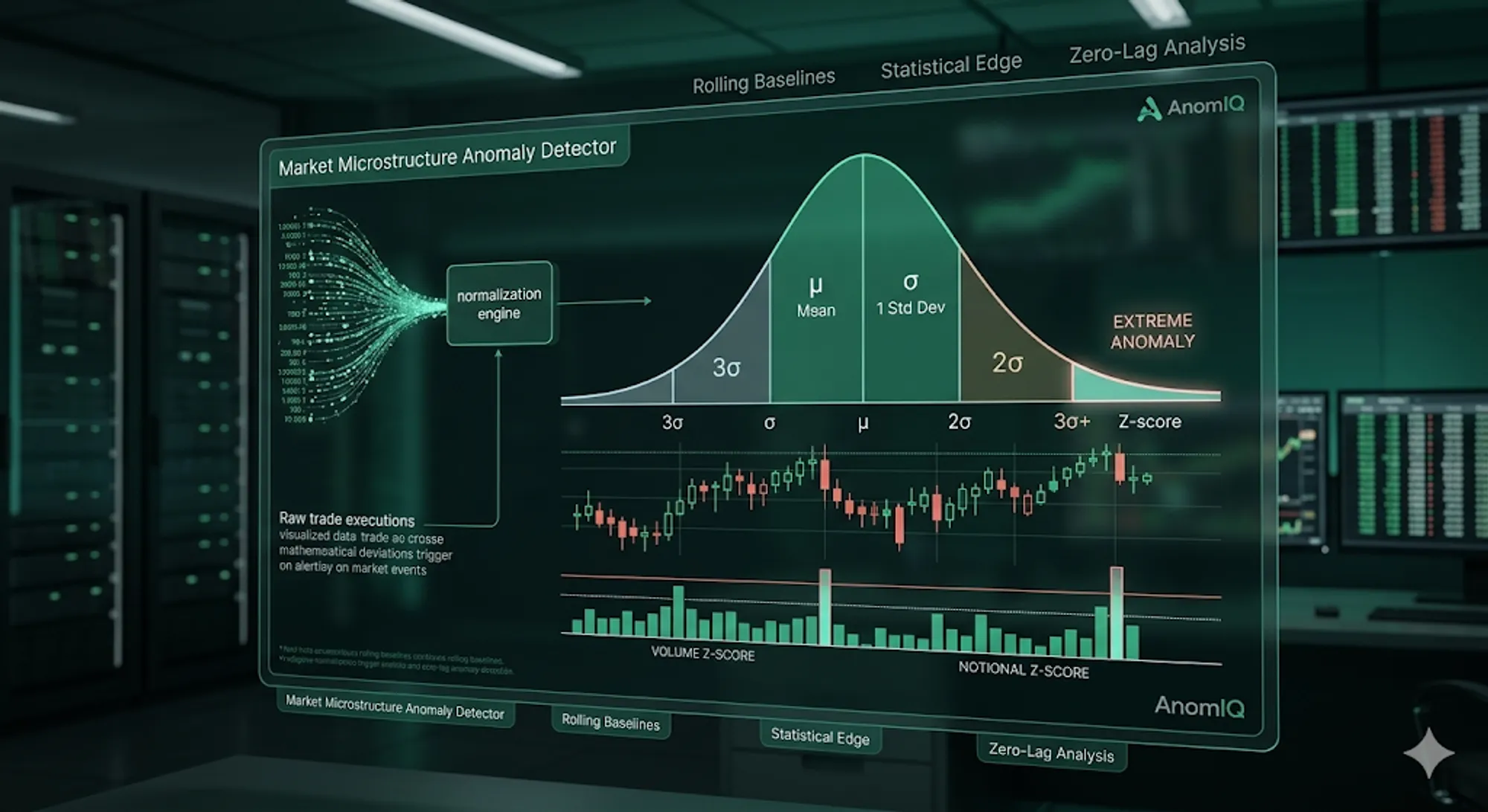
A z-score in trading measures how far a current value, such as volume, return, or trade count, sits from its own recent average, in standard deviations: Z = (Current Value - Mean) / Standard Deviation. A reading of 2.0 means the value is two standard deviations above normal for that market.
On a trading desk, a raw number is only useful after you know what is normal for that market. The same value can be routine on BTC, unusual on a smaller perpetual, and meaningless on an illiquid pair.
The trader’s question is simple:
Is this market doing something unusual compared with its own recent history?
That is why z-scores work well in live scanners. They turn noisy tape data into relative readings, so you can compare different symbols and metrics without pretending one raw threshold fits every market.
This article covers the general meaning, formula, thresholds, and scanner use cases. For volume-specific rules, use the dedicatedvolume z-score trading guide.
What Is a Z-Score in Trading?
In statistics, a z-score (or standard score) measures how far a specific data point deviates from the historical average, expressed in standard deviations.
The math is calculated as: Z = (Current Value - Mean) / Standard Deviation
Where:
- Current Value: The latest real-time measurement, such as return, volume, spread, volatility, or trade count
- Mean: The historical average of that specific metric
- Standard Deviation: The measure of how much the metric normally varies (volatility)
For example, if a market’s 5m volume has a rolling mean of $2.1 million and a rolling standard deviation of $600,000, a current reading of $3.9 million produces:
Z = (3,900,000 - 2,100,000) / 600,000 = 3.0That reading crosses the “rare” threshold below, regardless of whether $3.9 million looks large or small in isolation for that instrument.
For trading applications, the interpretation is straightforward:
| Z-Score | Statistical Meaning | Market Interpretation |
|---|---|---|
| 0 to 1 | Average | Normal background noise. |
| 1.0 to 2.0 | Elevated | Above normal, but common in active markets. |
| 2.0 to 3.0 | Unusual | Far enough from baseline to inspect the surrounding context. |
| > 3.0 | Extreme deviation | Rare for that metric and instrument; useful only with confirmation. |
A z-score of 3.0 or higher means the reading is far from the recent baseline. In market analysis, that is a reason to inspect the tape, not a standalone long or short signal.
Why Z-Score Beats Fixed Thresholds
Raw thresholds are mathematically blind.
For example, a single fixed threshold can mean different things across volume, trade count, open interest, volatility, or spread data. The number may look large, but that does not tell you whether it is unusual for the instrument you are watching.
A z-score solves this problem by normalizing activity relative to the instrument’s own historical behavior.
Instead of asking, “Is this number large?” you are asking, “Is this reading statistically abnormal for this specific asset and metric?” This dynamic normalization is what makes it possible to run a market scanner across hundreds of instruments simultaneously without getting drowned in false positives.
Common Trading Metrics That Use Z-Scores
A useful scanner applies z-score normalization across several market metrics. Each metric answers a different question, so the number only makes sense when you know what was normalized.
1. Total Volume Z-Score
Total Volume Z-Score measures whether traded activity is unusual relative to a market’s own baseline. The detailed workflow belongs in the volume z-score trading guide.
- Total Volume Z-Score > 3.0: Indicates a rare participation surge. These deviations often coincide with repricing, news, or sudden execution flow.
See it in action: You can visualize these exact statistical deviations minute-by-minute using the Volume Anomaly Histograms in the new Deep Dive 2.0 dashboard.
If you want to inspect the same idea on a chart before building a scanner rule, use the free TradingView Volume Anomaly Indicator.
2. Intensity Z-Score (Volume vs. Trade Count)
Intensity Z-Score is computed as Total Volume Z-Score minus Total Trade Count Z-Score. It separates capital flow from order flow: the same volume z-score can come from a few large executions or a flood of small ones, and only one of those points to larger average execution size.
- If Total Volume Z-Score is high (e.g., 3.2) but Total Trade Count Z-Score is low (e.g., 0.9), more notional is moving through fewer transactions. That points to larger average execution size rather than simple trade-count noise, the pattern this metric associates with institutional or block-sized flow.
3. Buy Volume Z-Score and Sell Volume Z-Score
Buy Volume Z-Score and Sell Volume Z-Score separate aggressive taker-buys from taker-sells, providing insight into which side of the market is dominating the tape.
- If Buy Volume Z-Score is
3.5and Sell Volume Z-Score is0.4, the anomaly is heavily skewed toward buyers. Tracking this directional asymmetry helps analysts identify aggressive accumulation or distribution phases as they develop in the tape.
Rolling Z-Score: Static vs Rolling Baselines
A rolling z-score recalculates the mean and standard deviation over the most recent N observations each time a new one arrives, then scores the current value against that moving baseline:
Rolling Z = (x_now - mean of last N) / std dev of last NN sets the tradeoff. A short window adapts quickly when volatility changes, but it also absorbs a sustained shift into “normal” within a few periods. A long window is stable but slow: after a regime change, readings stay inflated until enough new data enters the window.
| Static baseline | Rolling baseline | |
|---|---|---|
| Mean and std dev computed | Once, over a fixed historical period | Continuously, over the last N observations |
| Typical use | Backtests, end-of-day analysis | Live scanners, intraday alerts |
| After a volatility regime change | Stale until recalculated | Adapts as old observations leave the window |
| Main failure mode | Persistent false readings after the regime shifts | A slow trend gets absorbed into the baseline |
Most z-score explanations describe the static version. That works for after-the-fact analysis, but a live scanner needs the reading while the window is still forming. The engineering cost of doing that math without lag is covered in why perfect math broke the real-time scanner.
How AnomIQ sets the rolling windows
Each timeframe has its own baseline, built from earlier windows of the same length that slide forward one minute at a time:
| Timeframe | Baseline | Approximate history |
|---|---|---|
| 5m | 60 earlier 5m windows | Previous hour |
| 15m | 300 earlier 15m windows | Previous five hours |
| 60m | 1,440 earlier 60m windows | Previous day |
Three details matter when you read the number:
- The baseline excludes the window being scored, so a spike cannot inflate its own reference point.
- The current value includes the 1-minute bar still forming, so the reading moves before the window closes.
- A reading needs at least 30 baseline samples. For a newly listed symbol or after a data gap, the z-score stays at 0 until the baseline fills.
For the full production pipeline across volume, trade count, and trade size, read How to Detect Crypto Volume Anomalies in Real Time (Binance USDT + Coinbase USD).
Frequently Asked Questions
What does a z-score measure in trading?
It measures how far a current value, such as volume, return, or trade count, sits from that metric’s own historical average, expressed in standard deviations. The same raw reading can be routine on one instrument and unusual on another because each baseline is calculated separately.
What is the formula for calculating a z-score?
Z equals the current value minus the mean, divided by the standard deviation: Z = (Current Value - Mean) / Standard Deviation. The current value is the latest real-time reading, the mean is that metric’s historical average, and the standard deviation measures how much the metric normally varies.
What z-score counts as unusual?
A reading of 0 to 1 is average background noise, 1.0 to 2.0 is elevated but common in active markets, 2.0 to 3.0 is unusual and worth inspecting, and anything above 3.0 is an extreme deviation that is rare for that metric and instrument.
Does a z-score above 3 mean I should act on the market?
No. A z-score of 3.0 or higher just means the reading is far from its recent baseline. That is a reason to inspect the surrounding market context, not a standalone signal on its own.
Why use a z-score instead of a fixed threshold?
A fixed threshold means something different for every metric and instrument, since it ignores what is normal for that specific asset. A z-score normalizes each reading against the instrument’s own historical behavior, which is what lets a scanner compare hundreds of instruments at once without one raw number drowning everything in false positives.
Why do z-score baselines need to update continuously instead of using a fixed daily average?
A static baseline like a fixed daily average goes stale as intraday volatility shifts. Rolling statistical windows recalculate the mean and standard deviation as new data arrives, so the baseline adapts to changing volatility and anomalies can surface during the active window instead of waiting for a candle to close.
What is a rolling z-score?
A rolling z-score scores the current value against the mean and standard deviation of the most recent N observations, recalculated as each new observation arrives. It adapts to volatility changes that make a fixed-period baseline stale. In AnomIQ, the 5m, 15m, and 60m baselines use 60, 300, and 1,440 earlier windows of the same length.
Automate Your Statistical Anomaly Detection
Statistical anomaly detection is not a trading strategy on its own, but it is the foundational framework for discovering the exact moments where market behavior deviates from the norm. Those deviations are the starting point for structural analysis.
Calculating rolling standard deviations across hundreds of assets manually is not realistic.
AnomIQ automates this math. The engine ingests raw tick data and applies continuous z-score normalization across volume, trade count, and notional flow. You can translate those metrics into alerts with pre-built scanners or custom multi-timeframe filters.