
Open Interest Scanner: Reading OI Change With Taker Flow

Trader turned software engineer, with 4+ years building systems for crypto exchanges. Founder of AnomIQ, a real-time crypto anomaly scanner for quantitative traders.
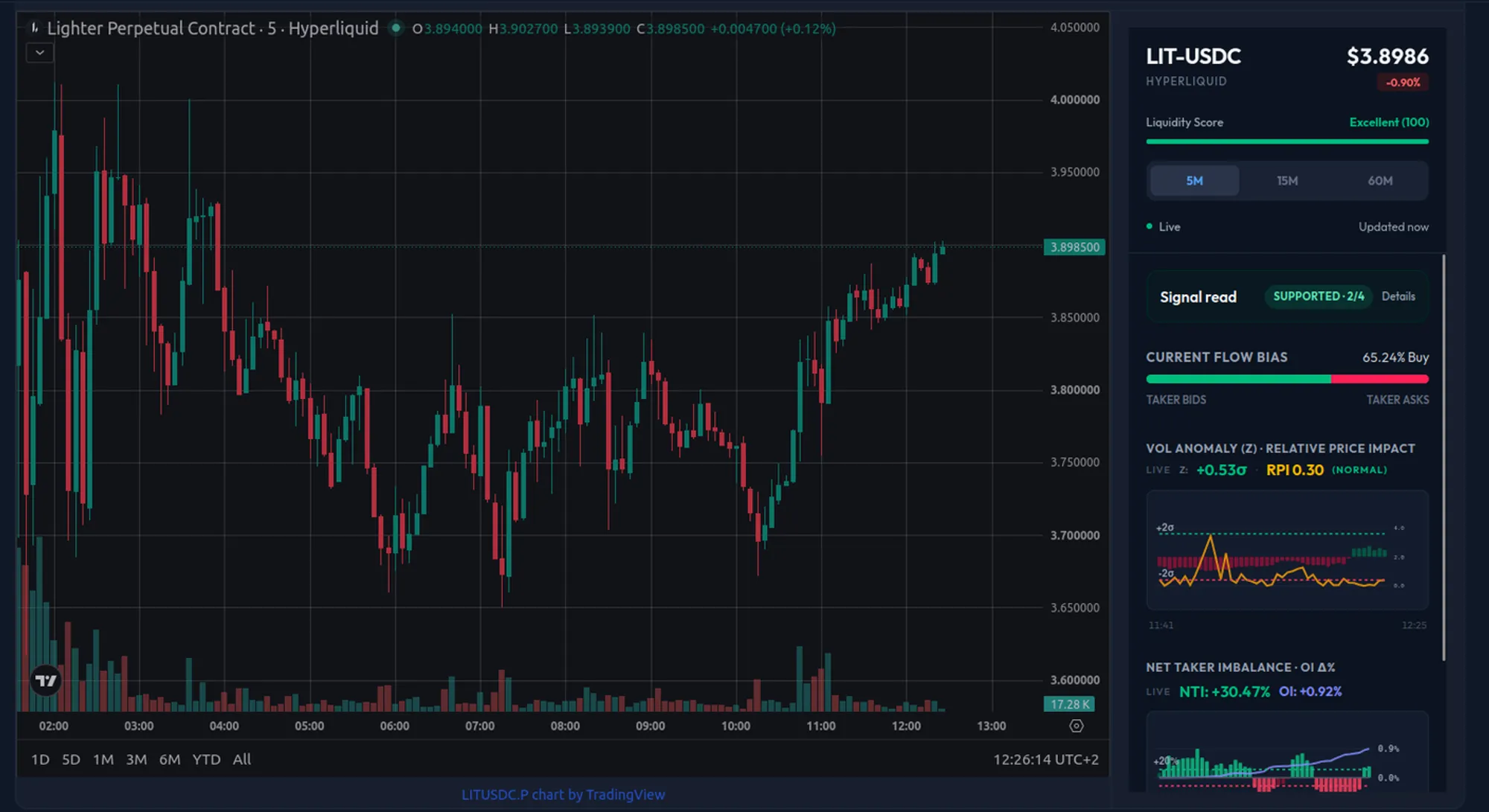
Open interest rising on a perpetual contract is direction-neutral. Every new contract adds one long and one short simultaneously. The taker, the participant who crossed the spread to open that contract, is the only source of directional information in the move.
Reading raw OI as bullish or bearish without taker flow is the most common misread in perpetual futures analysis.
AnomIQ tracks open interest on every Binance and Hyperliquid perpetual as a percentage change over six fixed windows in the scanner, and as a live overlay in the Deep Dive.
How AnomIQ Measures OI Change
OI Change % compares current open interest with the open interest at the close of the 1-minute bar N minutes earlier:
OI Change % = (OI now - OI N minutes ago) / OI N minutes ago × 100It is tracked over six windows: 1m, 5m, 15m, 60m, 120m, and 240m. The short windows (1m, 5m, 15m) catch position flow as it develops. The long windows (60m, 120m, 240m) tell you whether you’re watching a brief spike or a multi-hour capital build.
Open interest refreshes about every 10 seconds on Hyperliquid and every 10 to 15 seconds per contract on Binance, where AnomIQ cycles through every perpetual within the exchange’s rate limit. Spot markets have no open interest, so these filters only match perpetuals.
Why OI Is Direction-Neutral on Its Own
Every open interest contract represents a matched pair: one trader long, one trader short. Rising OI means new capital entered the market. Falling OI means traders closed positions or got liquidated. Neither shows which side initiated.
The aggressor is the taker, the participant who crossed the spread with a market order. If open interest rises and the predominant taker flow over the same window is buy-side, the new longs were most likely opened by buyers lifting offers. If OI rises while taker flow is sell-side, the new shorts were most likely opened by sellers hitting bids.
OI Change % gives you magnitude. AddNet Taker Imbalance for direction.
The Four Signal Combinations
OI direction and taker flow direction produce four scenarios with distinct positioning interpretations:
| OI Change % | Net Taker Imbalance | Interpretation |
|---|---|---|
| Rising | Bullish (buy-side) | New longs opening. Capital committing to long side. |
| Rising | Bearish (sell-side) | New shorts opening. Capital committing to short side. |
| Falling | Bullish (buy-side) | Short positions closing. Possible squeeze or stop-out. |
| Falling | Bearish (sell-side) | Long positions closing or getting liquidated. |
Both rising-OI scenarios mean capital is committing to a new directional position. Both falling-OI scenarios mean existing positions are exiting, forced by liquidation or by choice. Neither predicts continuation.
For one session where both falling-OI states appeared within hours, see the RAVE-USDT short squeeze case study: open interest fell during a rally at 12:20 and again, by more, during a sell-off at 13:50-14:20.
Choosing a Window: Fast Flow vs Structural Build
OI Change % tells you the direction and magnitude of the OI shift. Which of the six windows to filter on depends on what you’re trying to catch.
For 1m, 5m, and 15m filters, use a raw threshold. These windows catch real-time position flow as it develops:
OI Change % (15m) > 1.0: OI grew 1% in the last 15 minutesAt 60m, 120m, and 240m, you’re checking for a sustained commitment, not a single spike. A 240m OI build that lines up with taker imbalance describes a more sustained commitment than a single 5m spike.
The product’s suggested starting minimums are 0.2% on 1m, 0.5% on 5m, 1.0% on 15m, 2.0% on 60m, 3.0% on 120m, and 5.0% on 240m. To keep thin contracts from firing on small position changes, pair it with Today Volume in $ (the product suggests at least 500,000) and Liquidity score above 80. The Open Interest filter can’t do that job across symbols: it counts coins, not dollars, so 1,000 means 1,000 BTC on BTC but 1,000 tokens on a $0.01 coin.
Use OI Change % with Taker Imbalance Z-Score together: OI is shifting at a rate above your threshold, and the taker flow driving it is statistically unusual in the same direction.
Combining OI With Volume Z-Score
Volume Z-Score measures whether raw execution flow is statistically elevated. Open interest measures whether new positions are accumulating. They answer different questions.
That distinction matters because abnormal execution flow alone is not a clean directional forecast. In a separate 16,726-event study of big crypto move predictors, volume imbalance direction stayed close to a coin flip, while move size related more to volatility, price impact, location, and BTC linkage.
High volume with flat OI means traders are exchanging contracts at elevated pace without creating net new exposure. This profile fits scalping activity, stop-out cascades at clustered levels, or heavy two-sided liquidity consumption.
High volume alongside rising OI means the execution surge translated into new committed positions. That pairing means the activity is adding new exposure, not just turnover.
| Volume Z-Score | OI Change % | What it suggests |
|---|---|---|
| High | Flat / near zero | High turnover, no new commitment |
| High | Rising | Heavy turnover that is adding new positions |
| Low | Rising | Quiet accumulation, OI building without price noise |
| Low | Flat | Normal conditions |
Watch quiet OI accumulation: rising OI Change % with a normal volume z-score. It shows positions building before volume reacts. It’s a condition to watch, not a forecast: AnomIQ hasn’t tested whether it leads to a larger move.
Combining OI With Trend Cleanliness
Trend Cleanliness measures how much of the high-to-low range was covered by the open-to-close body. A high value means the price moved with low internal retracement.
Rising OI, bullish taker flow, and trend cleanliness above 75% in the same window stack three independent confirmations:
- New longs are opening (rising OI + bullish NTI)
- Execution flow is statistically elevated (volume z-score)
- Price is moving with structure rather than whipping (trend cleanliness above 75%)
Falling trend cleanliness during a rising OI + bullish NTI window signals possible absorption: new buyers are opening positions but the price is not advancing cleanly. Large passive sell-side interest may be absorbing the taker flow. This is the setup described in Order Flow Absorption. For the broader taker-flow scanner framework, see Crypto Order Flow Trading.
Practical Scanner Filters
New position buildup, buy-side
New longs opening at a meaningful rate with taker flow confirmation. OI Change % sets the activity threshold at this timeframe.
OI Change % (15m) > 1.0
Taker Imbalance Z-Score (15m) > 2.0
Net Taker Imbalance (15m) > 20
Total Volume Z-score (15m) > 1.5
Position unwinding, bearish
Longs closing into sell-side taker pressure. Potential capitulation or liquidation.
OI Change % (15m) < -1.0
Net Taker Imbalance (15m) < -20
Total Volume Z-score (15m) > 2.0
Quiet OI accumulation
No volume spike, but open interest is building steadily. Use it to find contracts where positioning is changing before volume does.
OI Change % (60m) > 2.0
Total Volume Z-score (60m) < 1.0
Turning an OI Filter Into a Live Alert
Save any filter combination above as a scanner. AnomIQ checks it continuously against every tracked perpetual and records each match on your dashboard, even while you’re away. On the paid plan, matches also go to Telegram or NTFY, so the dashboard doesn’t need to be open.
Free accounts get web-only alerts on a 30-minute delay. Paid accounts get real-time delivery as soon as an OI update meets your filter criteria (open interest refreshes every 10 to 15 seconds), push notifications through Telegram Private Notifications or the NTFY mobile app, and up to 10 concurrent scanners instead of 2.
See How to Get Alerted on Open Interest Changes for the step-by-step setup.
What the Deep Dive Shows
On perpetual markets, the Deep Dive overlays an indigo OI Δ% line on the Net Taker Imbalance chart: the change in open interest since the first bar on the chart, which is 45 minutes back on the 5m tab, 90 minutes on the 15m, and 6 hours on the 60m. The panel loads the last 6 hours of history when it opens, so the line is there from the start.
This line isn’t the scanner’s OI Change % filter, which uses the fixed windows above, so expect the two numbers to differ. Read it against the NTI bars: a run of bars where open interest and taker flow move together shows positioning that persisted, rather than one unusual minute.
Frequently Asked Questions
Does rising open interest on a perpetual contract mean price is about to go up?
Not on its own. Every new open interest contract represents one trader going long and one trader going short, so rising OI only shows that new capital entered the market, not which side initiated it. AnomIQ pairs OI Change % with Net Taker Imbalance to identify which side, buyers or sellers, was crossing the spread during that window.
What time windows does AnomIQ use to track open interest changes?
AnomIQ tracks OI Change % across six fixed windows, 1m, 5m, 15m, 60m, 120m, and 240m, for every Binance and Hyperliquid perpetual contract. The short windows catch real-time position flow as it develops, while the longer windows show whether a move is a brief spike or a multi-hour capital build.
What is the difference between OI Change % and Net Taker Imbalance?
OI Change % measures the magnitude of open interest growth or shrinkage over a given window, as a percentage of the OI at the start of that window. Net Taker Imbalance measures which side, buyers or sellers, was driving execution flow over the same window. Used together, OI Change % gives magnitude and Net Taker Imbalance gives direction.
What does it mean when open interest falls while taker flow is bullish?
That combination usually means short positions are closing rather than new longs opening, since buy-side taker pressure is covering existing shorts. AnomIQ’s framework flags this pattern as a possible squeeze or stop-out rather than fresh directional conviction.
Why would AnomIQ flag rising open interest even when volume looks normal?
Because open interest can build quietly, with OI Change % rising while Volume Z-Score stays near normal levels. That is new positioning without a volume spike, so it’s worth tracking separately from high-volume position building. Whether it leads to a larger move hasn’t been tested on AnomIQ’s data, so treat it as a condition to watch, not a forecast.
What’s the difference between free and paid alerts for open interest scanners on AnomIQ?
Free accounts get web-only alerts on a 30-minute delay and can run up to 2 scanners at once. Paid accounts get real-time delivery as soon as an OI update meets your filter criteria (open interest refreshes every 10 to 15 seconds), push notifications through Telegram or the NTFY app, and up to 10 concurrent scanners.
Open interest data is live across all tracked Binance and Hyperliquid perpetual contracts.