
Relative vs Absolute Signals: Why Fixed Thresholds Fail

Trader turned software engineer, with 4+ years building systems for crypto exchanges. Founder of AnomIQ, a real-time crypto anomaly scanner for quantitative traders.
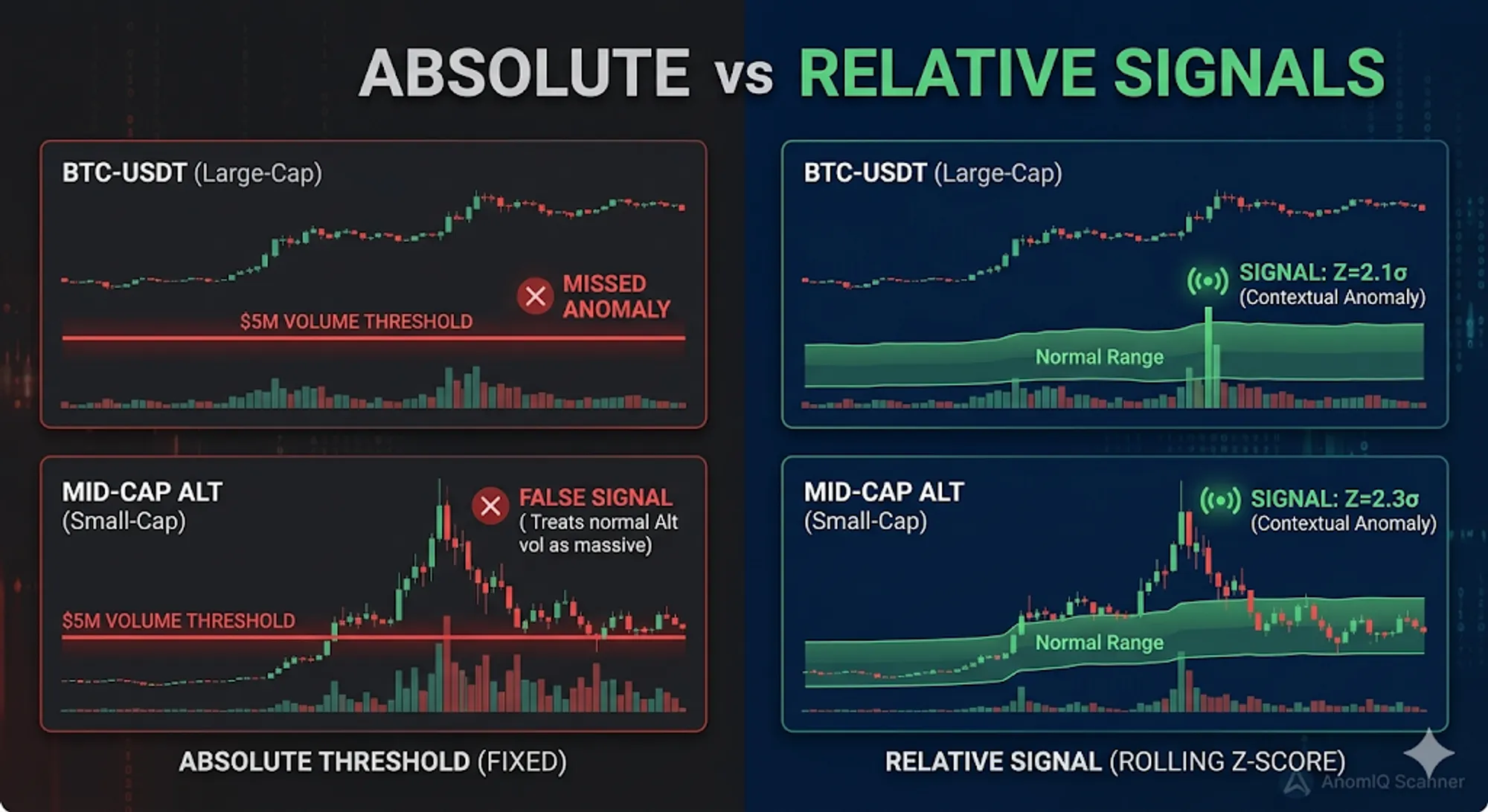
A scanner fires at $5M volume. On BTCUSDT at 14:00 UTC, that is a quiet minute. On a mid-cap altcoin at 03:00 UTC, it is the most active minute the asset has seen all week. Same threshold, opposite situation. Fixed cutoffs measure absolute size and have no mechanism to distinguish the two.
What a Fixed Threshold Measures
A fixed threshold checks whether the current value exceeds a preset number. It cannot tell whether that number is unusual for this asset at this time.
Volume varies by liquidity, market cap, time of day, and volatility regime. $10M on ETH-USDT is unremarkable during a London session. On a mid-cap altcoin at the same hour, it signals something structural in the order book. A scanner with a single cutoff treats both identically.
Price moves have the same problem. A 2% candle on a liquid perpetual contract is noise. On an asset with thin order books and 40% daily volatility, it may already be halfway through its move.
What a Relative Signal Measures
A relative signal measures whether the current reading is statistically unusual for this specific asset right now.
The mechanism is arolling z-score:
z = (current_value - rolling_mean) / rolling_stddevThe rolling mean and standard deviation come from the asset’s own recent activity, not a global benchmark. A z-score of 2.0 means the current reading sits two standard deviations above that asset’s own baseline. The threshold applies identically to BTCUSDT and to a token with 0.1% of Bitcoin’s liquidity. Both are measured against their own baselines, so the reading means the same thing on either: statistically unusual for this instrument right now.
For the volume-specific version of this workflow, including buy volume z-score, sell volume z-score, and concentration metrics, see Z-Score Volume Anomaly Detection in Trading.
Each asset supplies its own reference point. The threshold self-calibrates without any manual input.
Why This Matters Across Market Caps
Absolute thresholds require separate calibration for each market cap range. Set the cutoff high enough for BTC and it never fires on a small-cap. Set it low enough for the small-cap and it fires on BTC through quiet sessions. There is no single number that works for both.
A 2σ deviation on BTC and a 2σ deviation on a small-cap are equally anomalous for their respective instruments. The z-score normalizes against each asset’s own baseline. The filter needs no knowledge of market cap, session volume, or volatility regime.
One preset, one threshold, covers the full market. A filter set to flag volume z-score above 2.0 applies to all tracked assets regardless of size. For why that per-coin baseline is what separates a real-time crypto scanner from a live price feed, see the companion piece.
Why Fixed Thresholds Go Stale
A threshold set in January may be meaningless by March. When a market shifts from low to high volatility, what triggered an alert last month reads as normal once the asset’s baseline volume has grown. Absolute thresholds need manual recalibration each time conditions change.
Rolling z-scores update continuously as new data arrives. When volume increases across a regime, the mean and standard deviation rise with it, so crossing 2.0σ requires more absolute volume than before. No manual adjustment needed.
What This Looks Like With Real Numbers
Two assets caught by the same scanner filter at the same moment, 15-minute volume z-score above 2.0:
| Asset | Daily Volume | 15m Vol vs Baseline | 15m Vol Z-Score |
|---|---|---|---|
| XPL-USDT | $7.7M | 3.2x | 3.58 |
| NEWT-USDT | $372K | 2.2x | 2.51 |
XPL trades twenty times more notional volume per day than NEWT. In absolute terms they are not comparable. The z-scores are, because each is calculated against that asset’s own rolling baseline. Both read above 2.0. Both are flagged.
A fixed threshold calibrated to catch an XPL event sits far above NEWT’s entire daily volume. Set it low enough to catch NEWT and it fires on XPL through normal sessions. The z-score above 2.0 handles both without adjustment.
Frequently Asked Questions
Why does a fixed volume threshold work for Bitcoin but not for a small-cap altcoin?
A fixed threshold only checks whether a value exceeds a preset number, so it cannot tell whether that number is unusual for a given asset. $10M in volume is unremarkable on ETH-USDT during a London session, but the same figure on a mid-cap altcoin at the same hour can signal something structural in the order book.
What is a rolling z-score and how is it calculated?
A rolling z-score is calculated as (current_value minus rolling_mean) divided by rolling_stddev, where the mean and standard deviation come from the asset’s own recent activity rather than a global benchmark. A reading of 2.0 means the current value sits two standard deviations above that specific asset’s baseline.
Can the same z-score threshold be used across assets with very different trading volumes?
Yes. Because each asset is measured against its own rolling baseline, a 2 standard deviation move on BTC and a 2 standard deviation move on a low-volume token are equally anomalous for their respective instruments. One preset, such as flagging a volume z-score above 2.0, applies across the full market without separate calibration per asset.
Why do fixed volume thresholds need constant recalibration?
A threshold set during one volatility regime can become meaningless once conditions shift. If an asset’s baseline volume grows over time, the level that triggered an alert last month may read as normal a few weeks later, forcing manual adjustment. A rolling z-score updates continuously as new data arrives, so no manual recalibration is required.
How can one scanner filter catch anomalies on both high-volume and low-volume assets at the same time?
Because the filter compares each asset to its own history rather than to a shared number. In one example, XPL-USDT traded about twenty times more daily notional volume than NEWT-USDT, yet both crossed a 15-minute volume z-score above 2.0 at the same moment, since each reading was calculated against that asset’s own rolling baseline.
What does AnomIQ apply z-scores to besides volume?
AnomIQ z-scores volume, Net Taker Imbalance, and Relative Price Impact against each asset’s own rolling window across three timeframes, which identifies what is statistically unusual for that specific instrument rather than relying on one fixed number for every asset.
AnomIQ runs relative signals across all tracked markets. Volume, Net Taker Imbalance, and Relative Price Impact are each z-scored against the asset’s own rolling window across three timeframes, identifying what is statistically unusual for that instrument.
The same preset flags anomalies on BTC, ETH, and assets with a fraction of their daily volume. The signal is always relative to that instrument’s own history. Order flow absorption uses the same logic to identify when large participants are active. Get started with the scanner to build your first filter.